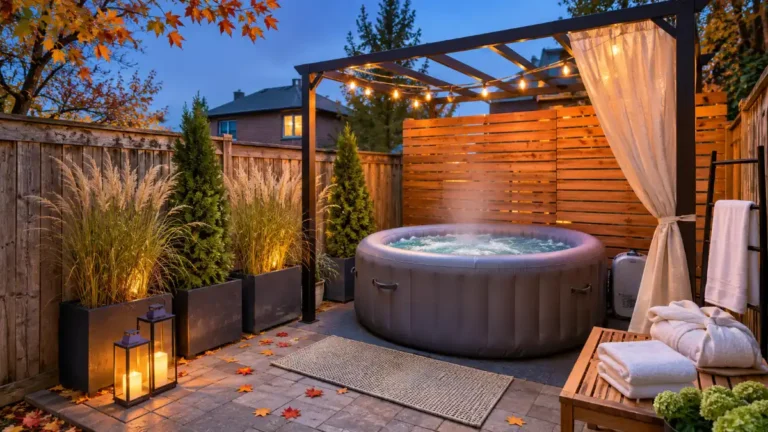
A hot tub in a small backyard usually comes with an audience. Townhouse rows, semi-detached lots and newer infill builds put a neighbour’s second-storey window a short distance from wherever the tub can go, and it is hard to relax when you are wondering who can see you.
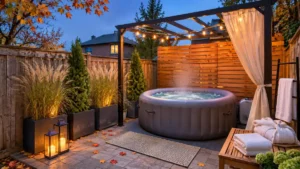
You can create a private hot tub retreat in a small backyard with four moves: place the tub where existing walls and fences already block the main sightlines, screen the most exposed side, use a pergola or tall planters to interrupt views from above, and keep the lighting low and warm. None of this needs a permanent build. That suits an inflatable hot tub well, because you can shift the tub and the screening until the layout works.
Why Privacy Matters When Creating a Backyard Hot Tub Retreat
Privacy decides how often the tub gets used. A spa that feels exposed tends to sit under its cover; one that feels enclosed becomes part of the evening routine.
The same screening does other useful jobs:
- It blocks wind. Moving air is what makes a January soak uncomfortable, and it pulls heat from the water.
- It softens sound and light. Your neighbours benefit from the screen as much as you do.
- It defines the space. In a compact yard, a screened corner reads as an outdoor room instead of a tub parked on the patio.
1. Choose the Right Location for Your Hot Tub
The best location is a level, ground-level spot where the house wall and a fence already cover two sides. Every side that is blocked for free is one you do not have to build.
To find it:
- Sit on a low chair in each possible spot, at roughly the height your head will be in the water.
- Note which windows, decks and balconies you can see. If you can see them, they can see you.
- Pick the spot with the fewest open sightlines, then plan screening only for what remains.
Privacy is not the only test. The spot also needs:
- A flat, stable surface that can carry a filled tub.
- A suitable outdoor outlet within reach of the tub’s own cord.
- Room to reach the pump and heater unit, remove the cover and step in safely.
- A short, clear walk to the door. This matters a great deal in February.
- Distance from roof edges where snow and ice slide off.
Before committing, check your municipal bylaws and any condo, strata or homeowner association rules. Requirements for hot tubs differ from place to place.
2. Install Privacy Screens for Your Hot Tub Area
A hot tub privacy screen is a freestanding or post-mounted panel that blocks one sightline without enclosing the whole yard. In a small space, one or two well-placed panels usually do more than a full perimeter of fencing.
Wooden privacy screens
Cedar and pressure-treated lumber are the common choices. Horizontal slats with narrow gaps hide the tub while letting air and some light through, which keeps the corner from feeling boxed in.
Outdoor decorative screens
Laser-cut metal and composite panels act as both screen and feature wall. They need little upkeep and suit modern townhouse patios. Confirm that the panel and its hardware are rated for outdoor use.
Lattice panels
Lattice is the affordable option. On its own it gives partial cover. With a climbing plant, or a second layer offset behind it, the coverage improves considerably.
Privacy fencing
A taller or more solid fence section gives the most complete backyard hot tub privacy. Fence heights are regulated locally, and shared fences involve your neighbour, so confirm the rules before you build.
3. Use Plants and Greenery to Create Natural Privacy
Plants screen a hot tub more gently than panels and take the hard edge off a fence. The trade-off is time, and in most of Canada, the season.
Tall ornamental grasses
Upright grasses such as feather reed grass grow quickly and take up little ground. They are cut back in spring, so expect a gap in coverage until the new growth fills in.
Evergreen plants
Cedars and upright junipers hold their foliage all year, which makes them the dependable choice for a tub used in winter. Columnar varieties suit narrow beds along a fence.
Privacy hedges
A hedge gives the fullest natural screen, but it needs depth and several seasons to fill in. In a very small yard, a single row of columnar evergreens gives a similar result in less space.
Container plants
Planters are the most flexible choice for inflatable hot tub privacy, because they move when the tub does. Roots in pots get colder than roots in the ground, so choose hardy plants for your zone or treat the display as seasonal.
Keep all planting far enough back that leaves and needles do not drop into the water or crowd the pump unit.
4. Add a Pergola or Outdoor Canopy
A pergola or canopy solves the problem fences cannot: the view from above. If the main exposure is an upstairs window, overhead cover is the most direct fix.
Open pergolas
A slatted roof breaks up the downward view while keeping the sky visible. Outdoor curtains or a slatted panel on one side add cover exactly where it is needed.
Retractable canopies
A canopy that slides or rolls back lets you choose between shade and privacy or open sky. It can also be retracted before heavy snow.
Weather-resistant outdoor coverings
Look for outdoor-rated fabric, powder-coated aluminium or treated wood. Fabric panels generally come down for winter unless the manufacturer states otherwise.
Any structure over a hot tub should be freestanding, properly anchored and tall enough that you can lift the cover off and stand up safely. Nothing should be attached to or resting on an inflatable tub. Some municipalities require a permit for pergolas, so check before you build.
5. Create Privacy Without Making Your Backyard Feel Smaller
Screen the sightline, not the yard. A small space closes in quickly when every side gets a tall, solid wall.
- Cover only what is exposed. One panel angled toward the neighbour’s window often does the job of a full enclosure.
- Choose semi-open materials. Slats, lattice and grasses hide a seated person while letting light and air through.
- Vary the heights. A tall screen on one side and waist-high planters on another feels more open than uniform walls.
- Stay light in colour. Natural cedar and pale stains reflect light; dark solid panels absorb it.
- Leave one view open. A sightline to the garden or the sky stops the corner from feeling like a box.
6. Choose the Right Lighting for a Private Spa Atmosphere
Low, warm, downward-facing light makes a hot tub area feel private. Bright overhead light does the opposite, because it puts you on display to every dark window nearby.
Practical choices include solar stake lights along the path, warm string lights under a pergola, and shielded fixtures on a screen or fence. Light the route from the door and the step into the tub first, since that is where the safety risk is.
Use only fixtures rated for outdoor and wet locations, and keep mains-powered lighting and cords well clear of the water. Solar and low-voltage products are the easier choice beside a tub.
7. Use Outdoor Accessories to Enhance Your Hot Tub Retreat
Accessories are what turn a screened corner into a small outdoor spa. A few carefully chosen pieces work better than many in a tight space.
- Outdoor mats: A ground mat under an inflatable tub protects the base. A non-slip mat at the entry keeps grit out of the water and gives wet feet some grip.
- Storage solutions: A slim deck box holds test strips, chemicals and spare filters. Store chemicals according to their labels and out of children’s reach.
- Towel holders: A freestanding rack or hooks on the privacy screen keep towels and robes within arm’s reach.
- Comfortable seating: One bench or a pair of folding chairs is plenty. A storage bench does two jobs.
- Privacy-friendly decorations: Outdoor curtains, a trellis with climbers or a row of tall lanterns add screening as well as character.
8. Consider Weather Conditions in Canadian Backyards
Anything you build around a hot tub in Canada has to cope with wind, snow, rain and repeated freezing and thawing. A setup that looks good in July can fail in its first winter.
- Wind: A solid screen catches wind like a sail. Slatted designs let gusts pass through, and freestanding screens need secure anchoring or weighted bases. Work out your prevailing wind direction before you choose a side to screen.
- Snow: Take down fabric canopies and shade sails for winter unless they are rated for snow. Clear the tub cover and the path regularly.
- Rain and drainage: Avoid low spots where water collects. Standing water around the base turns to ice.
- Materials: Cedar, pressure-treated lumber, powder-coated aluminium and composites last well outdoors. Use exterior-grade fasteners, since ordinary steel rusts and stains.
- The tub itself: Many inflatable hot tubs have a minimum outdoor operating temperature. Read your model’s manual before planning winter use, and follow its storage instructions if the tub is put away for the season.
9. Privacy and Safety Considerations for Inflatable Hot Tubs
Privacy features should never get in the way of safe operation. The manufacturer’s instructions come first, and the screening is designed around them.
- Stable surface: Set the tub on flat, level ground free of sharp objects. A filled hot tub is very heavy, so the weight capacity of any deck or balcony must be professionally assessed before a tub goes on it.
- Electrical safety: Plug the tub in exactly as the manual directs. Manufacturers typically call for a ground-fault protected outlet and advise against extension cords. If you lack a suitable outdoor outlet, hire a qualified electrician.
- Ventilation: The pump and heater unit needs airflow. Do not box it in with panels, planters or stored items.
- Access: Leave a clear path in and out, enough room to remove and replace the cover, and space to reach the controls and drain valve.
- Enclosure: An open-sided screen or pergola is safer than a sealed structure. Fully enclosing a hot tub traps heat and moisture.
- Securing the tub: Keep the cover on and fastened whenever the tub is unattended, and find out whether your municipality has fencing or gate rules for hot tubs.
Common Mistakes to Avoid When Creating a Private Hot Tub Space
- Building before sitting. Screens placed by eye from a standing position often miss the sightline that matters at water level.
- Forgetting the view from above. A fence does nothing about a second-storey window.
- Planning for summer only. Leafy screening that disappears in October leaves a winter tub exposed.
- Blocking the cover. A screen set too close makes the cover awkward to lift, and an awkward cover gets left off.
- Skipping the rules. Fence heights, pergolas and hot tubs can all be covered by local bylaws or condo rules.
How to Create a Private Hot Tub Retreat on a Budget
Start with what costs nothing, then add the cheapest fix for the worst sightline. Most small yards need less screening than their owners expect.
- Use the free cover. Tuck the tub into the corner made by the house and an existing fence.
- Fix one sightline at a time. A single lattice panel or outdoor curtain aimed at the most exposed side is the usual first purchase.
- Add planters. Tall grasses in containers are inexpensive, quick to fill out and easy to move.
- Light it with solar. Solar stake and string lights need no wiring.
- Build in stages. Live with the setup for a few weeks before buying more. An inflatable tub can be repositioned, so adjust the layout first and spend second.
Frequently Asked Questions
Here are some frequently asked questions given below:
How can I make my hot tub private in a small backyard?
Place the tub in a corner already covered by the house and a fence, then add a screen on the most exposed side. Use a pergola or canopy if neighbours can see in from above.
What is the cheapest way to create privacy around a hot tub?
Good placement is free. After that, lattice panels, outdoor curtains and tall grasses in containers are generally the lowest-cost options, and each can be added one at a time.
Can I use plants to create privacy around an inflatable hot tub?
Yes. Container plants work especially well because they can be moved with the tub. Keep them back from the water and the pump unit, and use evergreens if you need cover in winter.
Are privacy screens suitable for small backyards?
Yes. A single slatted or lattice screen takes up very little ground and blocks a specific sightline without enclosing the yard. Semi-open designs keep the space feeling larger than solid panels do.
Can I put a pergola over an inflatable hot tub?
Yes, provided the pergola is freestanding, securely anchored and leaves room to remove the cover and stand up. It should not touch or rest on the tub, and the sides should stay open for ventilation.
How much space should I leave around an inflatable hot tub?
Follow the clearance stated in your tub’s manual. As a practical minimum, you need room to walk around the tub, reach the pump and controls, take the cover off and keep air moving around the heater unit.
What is the best location for a hot tub in a small backyard?
A flat, ground-level spot close to the door, within reach of a suitable outlet and sheltered on two sides by the house and a fence. Avoid low areas where water pools and spots beneath roof edges.
Conclusion
A private hot tub retreat in a small backyard comes down to a short list: choose the most sheltered spot, screen the one or two sightlines that remain, add overhead cover if upper windows are the issue, and keep the lighting soft. Build with materials that can handle a Canadian winter, and let the tub’s manual set the limits on clearance, power and ventilation.
If you are still choosing a tub, an inflatable model gives you the freedom to try different positions before settling on a layout. You can browse the inflatable hot tubs and accessories at Hot Tubs Depot Canada to find a size that fits your space.